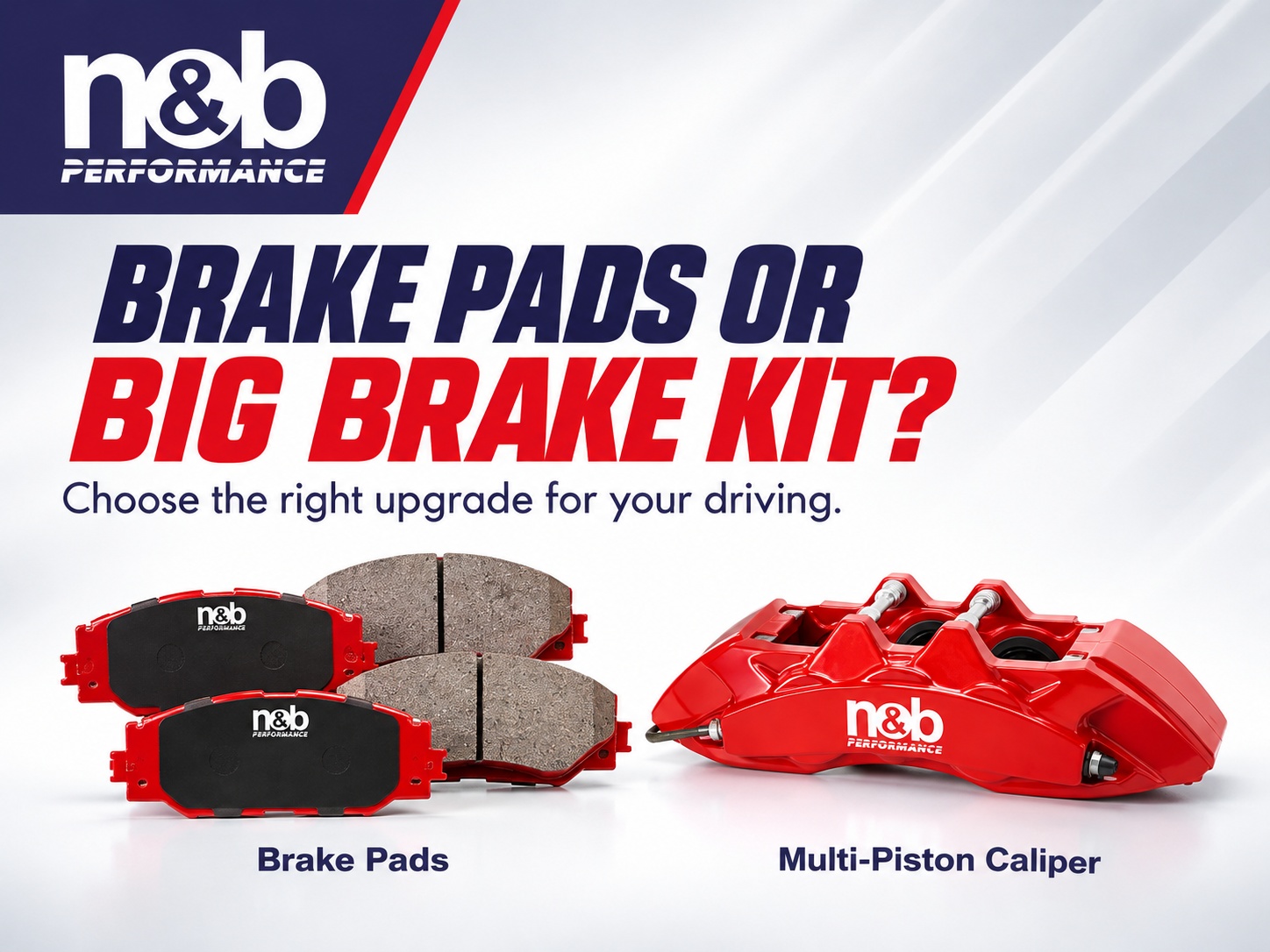
Do You Need a Big Brake Kit, or Are Upgraded Brake Pads Enough?
Upgraded brake pads may be enough if your existing brakes are in good condition and you want a compound better suited to your driving. If your brakes lose performance during repeated use, have the cause checked before deciding whether to upgrade the pads or the complete system.
At n&b Performance, we offer brake pads, brake discs, and big brake kits. We recommend starting with a clear goal: improving everyday braking response, maintaining performance during repeated braking, or selecting a complete package for more demanding use.
This guide explains how to compare those options and what to confirm before purchasing.
Contents
- What Is a Big Brake Kit, and What Does It Include?
- Are Upgraded Brake Pads Enough, or Should You Consider a Big Brake Kit?
- How Do Daily Driving, Mountain Roads, and Track Days Affect Your Brake Upgrade Choice?
- 4-Piston vs. 6-Piston Brake Kits: What Should You Compare?
- What Fitment Details Should You Check Before Buying a Big Brake Kit?
- How Can You Compare n&b Performance Brake Upgrade Options?
- Big Brake Kit FAQ
1. What Is a Big Brake Kit, and What Does It Include?
A big brake kit typically combines larger brake discs with compatible calipers, pads, brackets, and associated hardware. It changes several components together instead of replacing only the brake pads.
Brake rotors and brake discs are two names for the same component. During braking, the pads press against the discs, converting the vehicle’s kinetic energy into heat.
Our F401 and F601 big brake kits include a pair of calipers, a pair of two-piece brake discs, a brake pad set, stainless steel braided brake lines, caliper brackets, and mounting hardware. Confirm the configuration available for your vehicle before ordering.
The purpose of considering a complete kit is to evaluate the calipers, discs, and friction material together. A larger caliper alone does not establish how the complete system will perform.
Explore the product: 6 Piston Big Brake Kit - F601
2. Are Upgraded Brake Pads Enough, or Should You Consider a Big Brake Kit?
Consider upgraded pads if the existing hardware meets your needs but you want different braking response or a compound with a more suitable operating temperature range. If changing the pad compound cannot meet your braking needs, a complete kit may be worth considering.
Before choosing an upgrade, have the existing system checked. Worn discs, sticking calipers, deteriorated brake fluid, or installation problems require attention first.
Once the system is in good condition, compare the following options:
On smaller screens, scroll horizontally to view the full table.
| Your situation | Option to evaluate | Limitation |
|---|---|---|
| You want different braking response or a compound suited to your use | Compatible upgraded brake pads | Pads can improve high-temperature performance but do not increase disc size or thermal capacity. |
| Your discs need replacement while the existing calipers remain suitable | Compatible replacement discs and pads | Replacement discs do not necessarily provide the thermal capacity of a larger-disc kit. |
| Your intended use requires greater capacity during repeated braking | A complete big brake kit | Suitability depends on the selected configuration and vehicle. |
| You want to enhance the visual appearance of your braking system | A complete big brake kit | Wheel clearance and vehicle compatibility must be confirmed. |
| Braking performance changes unexpectedly or the pedal feels abnormal | Inspection and diagnosis | Performance parts should not substitute for identifying a fault. |
There is no fixed requirement to replace pads first and install a kit later. The appropriate choice depends on your current brakes, intended use, and upgrade goals.
If performance deteriorates during repeated braking, identify the cause before selecting parts. Friction-material fade and brake-fluid overheating are different problems and may require different responses.
Key Takeaways
- Diagnose faults before choosing an upgrade.
- Consider both performance and appearance goals while confirming vehicle compatibility.
Related article: Why Upgrade Your Brake Pads?
3. How Do Daily Driving, Mountain Roads, and Track Days Affect Your Brake Upgrade Choice?
How frequently and heavily you use the brakes matters more than choosing the highest specification available.
Daily driving
For commuting and family use, predictable response from cold, manageable noise, and practical maintenance are useful priorities.
If the existing calipers and discs meet your needs, compatible upgraded pads may be sufficient. A compound intended primarily for high-temperature use is not automatically the best choice for short urban journeys.
Mountain roads
Repeated braking on descents increases heat load. Pad operating range, disc condition, brake-fluid condition, and driving technique all affect performance.
Consider consistency over repeated braking rather than initial bite alone. Appropriate speed and engine braking remain essential on public roads.
Track days
Track sessions place greater demands on the braking system. Vehicle weight, speed, tires, session duration, and cooling conditions affect the required configuration.
Select racing brake pads and track pads for the actual application. Track suitability depends on the individual kit, pad compound, vehicle, and operating conditions; a kit’s included pads may not suit every track session.
Our brake pad categories include Premium Street, Performance, and Trackday & Circuit Racing. Check the individual product’s intended use when comparing compounds.
Our published SUZUKI Swift Sport (ZC33S) example uses F451 front four-piston calipers with 330 × 28 mm two-piece discs. It illustrates a specific vehicle configuration, rather than a recommendation for every compact car.
Related example: Big Brake Kit Upgrade Case: SUZUKI Swift Sport (ZC33S)
4. 4-Piston vs. 6-Piston Brake Kits: What Should You Compare?
Piston count is one specification, not a complete performance rating. Compare the calipers, discs, pads, and vehicle compatibility together.
Four-piston and six-piston calipers are also known as 4-pot and 6-pot calipers. More pistons do not automatically mean greater clamping force or a more suitable package.
| Comparison point | Why it matters |
|---|---|
| Piston dimensions and hydraulic area | Affect clamping force and fluid displacement in relation to the vehicle’s hydraulic system |
| Disc diameter | Affects braking leverage and packaging |
| Disc mass, material, and thickness | Influence thermal capacity |
| Disc ventilation and airflow | Influence heat dissipation during use |
| Caliper construction | Affects stiffness and dimensions |
| Pad compound | Determines friction behavior across its intended operating range |
| Front-to-rear matching | Affects the suitability of the complete brake setup |
Thermal capacity and cooling are related but different. A disc may absorb more heat because of its mass and material, while its cooling performance also depends on ventilation and airflow. Diameter alone cannot establish either.
Our F401 four-piston and F601 six-piston kits offer different caliper and disc combinations. The six-piston product page also lists F602 options separately, so check which caliper model corresponds to your selected disc dimensions.
Key Takeaways
- Compare complete configurations rather than piston count alone.
- Assess thermal capacity and cooling separately.
4 Piston Big Brake Kit - F401
Review the listed caliper specifications, disc configurations, and application requirements.
6 Piston Big Brake Kit - F601
Compare the listed six-piston configurations and confirm the model associated with the selected disc size.
5. What Fitment Details Should You Check Before Buying a Big Brake Kit?
Confirm the exact vehicle application and wheel clearance before ordering. Wheel diameter alone does not establish fitment.
Wheels with the same diameter can have different internal barrel shapes and spoke profiles. Both must provide clearance for the selected caliper and disc assembly.
Prepare the following information when contacting us or a dealer:
- Vehicle: make, model, year, trim, and market version.
- Existing brakes: factory configuration and previous modifications.
- Wheels: brand, model, diameter, width, offset, and any spacers.
- Intended use: commuting, mountain roads, or track days.
- Rear brakes: current configuration and parking-brake arrangement if considering rear upgrades.
Our product pages list minimum wheel sizes for certain configurations. These are initial references; actual barrel and spoke clearance still need confirmation.
Also confirm brake-line routing and clearance, parking-brake operation where applicable, and compatibility with the vehicle’s braking system.
Installation, bleeding, and final checks should be performed by a qualified technician. Follow the applicable bedding instructions for the selected pads and discs.
Key Takeaways
- Provide the exact vehicle version and wheel model.
- Confirm fitment before placing an order.
Related article: Brake Pads Installation and Bed-In Advice
6. How Can You Compare n&b Performance Brake Upgrade Options?
We offer several product categories for different upgrade goals. Availability varies by vehicle, so confirm the product and specifications for your exact application before ordering.
On smaller screens, scroll horizontally to view the full table.
| Your upgrade goal | Our relevant products | What to confirm |
|---|---|---|
| Change friction characteristics while retaining compatible hardware | Brake Pads | Pad shape, compound, and intended use |
| Replace discs while retaining the compatible original caliper configuration | OE Replacement Disc / 2-Piece OE Replacement Disc | Vehicle application and disc specifications |
| Evaluate a complete caliper-and-disc package | Four-, six-, and eight-piston Big Brake Kits | Vehicle availability, selected configuration, and wheel clearance |
| Evaluate larger rear discs without selecting a rear multi-piston kit | Rear Disc Upgrade Kit | Application availability and compatibility |
| Evaluate a rear multi-piston package | Rear 4 / 6 Piston Big Brake Kit - R401 / R601 | Front-to-rear matching and parking-brake compatibility |
Our OE Replacement Disc and 2-Piece OE Replacement Disc products are designed for specified vehicle applications that retain the original caliper setup.
The Rear Disc Upgrade Kit and rear big brake kits are separate options. Rear changes should be assessed as part of the complete brake setup. Our rear disc upgrade offering is not available for every vehicle.
Ask Us About Products for Your Vehicle
Send us your vehicle details, wheel specifications, current brake setup, and intended use. We can provide information on available products and specifications.
Contact n&b Performance → Explore Big Brake Kits →
For installation, have a dealer or qualified technician confirm the requirements, clearances, and compatibility on the vehicle.
More Articles to Help You Choose
Why Upgrade Your Brake Pads? →
Explore pad selection, braking response, and everyday considerations.
Brake Pads Installation and Bed-In Advice →
Review installation checks and bedding guidance.
Big Brake Kit Upgrade Case: SUZUKI Swift Sport (ZC33S) →
See a published F451 four-piston upgrade configuration.
Browse All News and Upgrade Cases →
7. Big Brake Kit FAQ
Select a question to expand or collapse the answer.
Q1:Will a big brake kit always shorten stopping distance? Select to open or close the answer
A1:No. Stopping distance also depends on tire grip, road conditions, vehicle load, ABS operation, and the existing brakes. If the original system already reaches the available tire grip in a single stop, an appropriately selected kit may offer more benefit in maintaining performance during repeated braking than in shortening that stop.
Q2:Can a big brake kit fit behind factory wheels? Select to open or close the answer
A2:Some combinations can. Fitment depends on the specific wheel and kit, including barrel shape and spoke clearance. Confirm the combination before ordering.
Q3:Do rear brakes need upgrading when fitting a front big brake kit? Select to open or close the answer
A3:Not automatically. Confirm whether the selected front package is appropriate with the existing rear brakes. If rear changes are considered, assess braking balance and parking-brake compatibility.
Q4:Are racing brake pads suitable for everyday driving? Select to open or close the answer
A4:It depends on the compound. Some prioritize elevated-temperature performance and may involve compromises in cold response, noise, or wear. Select pads according to their stated application requirements.
Q5:What replacement parts and maintenance costs should you consider? Select to open or close the answer
A5:Check replacement pad specifications, disc availability, applicable caliper service parts, and inspection requirements. For two-piece discs, confirm which replacement components are available for the specific assembly.
External reference: For independent information on tire condition, maintenance, and traction, visit NHTSA Tire Safety.
At n&b Performance, we encourage you to consider both the initial upgrade and its ongoing maintenance needs when choosing your brake setup.